
Top Tools for Predicting Current Events: What to Check
18 September 2026
The Short Answer: What a Current Events Tool Has to Get Right
A prediction market turns a question about the news into a price. Say a market on a policy decision trades at 62p. That price is the market's estimate that the answer will be yes. If the outcome happens, the contract settles at 100p. If it does not, it settles at 0p. The tool you use decides how clearly you can see that price, who is allowed to offer it to you, and what a position costs.
So rather than ranking apps for you, here are five checks you can apply to any platform yourself. They are the ones that change your experience most.
- A licence that covers you. Offering these markets in Great Britain requires a licence from the Gambling Commission, and operating them here without one is not legal. versus holds a licence under account 101143, which anyone can look up on the public register. Polymarket and Kalshi block UK users and are not licensed in the UK.
- A named settlement source. Every market should tell you, before you trade, which source decides the result. On versus that source is named on the market itself. A news question with no stated source is an argument waiting to happen.
- Prices you can actually read. A scale from 0p to 100p is easy to reason about, because the number is the probability. You can compare it directly with your own view.
- A fee you see before you confirm. On versus the transaction fee is 2% of your stake, added on top of the stake, with no cap, and shown before you confirm. It is the only fee on a trade. Deposits and withdrawals are free within normal limits.
- A way out before the result. While a market is open on versus you can sell your position at the current price, so a view you no longer hold does not have to be carried to the end.
Licensing Is the First Filter, Not the Last
Most of the differences that matter between prediction tools follow from the licence, not from the interface. A Gambling Commission licence is why customer money is held separately from company money, why there is an independent route for complaints, and why identity checks exist at all.
It also explains restrictions people sometimes find surprising. Licensed operators in Great Britain may not accept credit cards. Settlement happens in ordinary money rather than cryptocurrency. Before a first withdrawal you verify who you are with a photo of a government ID and a selfie, which is required under anti money laundering law and usually clears in minutes.
The temptation, when a platform is out of reach, is to route around it. It is worth being plain about that. Using a VPN to reach a platform that blocks UK users puts you outside that platform's terms and outside UK protection at the same time, which is the worst of both. If a tool is not licensed to serve you, treat it as unavailable rather than as a puzzle.
How to Read a Price on a News Market
Research suggests that markets with enough participants can be reasonably well calibrated, which is a careful way of saying the prices are often informative. It is not a promise, and no market is a forecast you can rely on. Prices move as opinion moves, and they can be wrong right up to settlement.
What a price does give you is a shared unit. If a market on an outcome sits at 62p and you think the real chance is closer to 40p, you have a disagreement you can act on. If you think it is closer to 62p, there is nothing to do, and that is a perfectly good result from reading the market.
A good tool helps here by showing the current price plainly, by naming the settlement source next to it, and by making it obvious what happens at 0p and 100p. If you have to hunt for the rules of a question, the interface is working against you. Our guide on how it works walks through a single trade from start to settlement.
Market Range: Politics, Finance and the Rest of the News
Breadth is worth less than people assume. A long list of markets is only useful if it includes the questions you already follow, and if those questions are defined tightly enough to settle cleanly.
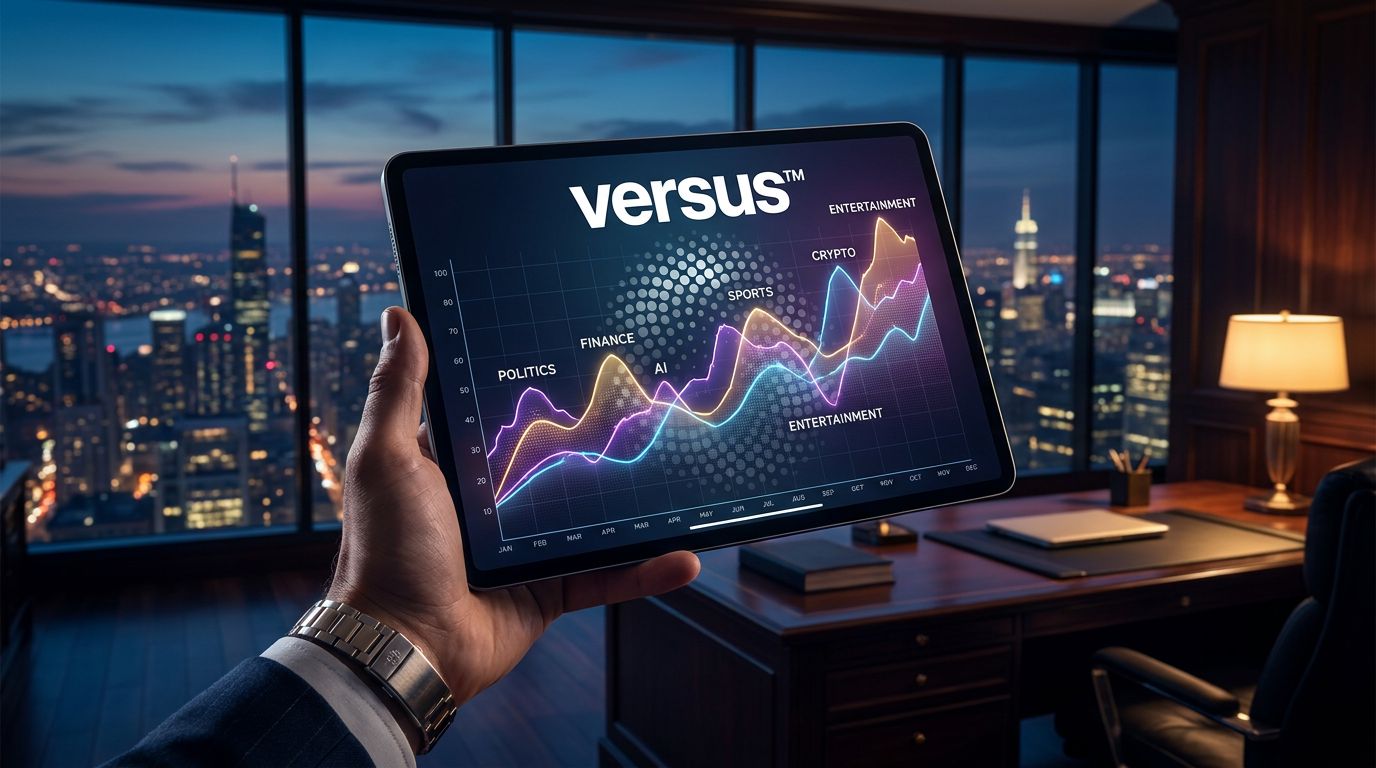
versus runs markets across politics, finance, sport, AI, crypto and entertainment, so a current events reader is mostly served by the politics and finance side, with the others there when a story crosses over. The practical test is simple. Pick the three news questions you have an opinion on this week, then see whether the platform has them, and whether you can tell from the market page exactly what would count as a yes. You can scan the current list on the predictions page.
What It Costs, and What You Can Lose
Costs on a per trade basis are easy to work out when there is only one of them. On versus, the 2% transaction fee is added on top of your stake. Say you put 500p into a position: the fee is 10p, so 510p leaves your balance, and you see that total before you confirm.
The more important number is the downside. Your loss can never exceed what you put into a position. There is no leverage and no margin call, so a position cannot turn into a debt. That is a structural point about how these contracts work, not a reason to treat them as low risk: you can lose the whole amount you put in, and that is the normal outcome for a losing position.
Withdrawals return to the method you deposited with, and the timings depend on that method and are shown in the app. The FAQ covers the verification step and what to expect.
Where and How You Use the Tool
Day to day, access matters. versus runs as an iPhone app on the App Store, listed as "versus | Prediction Markets", as an Android download direct from the versus website, and as a web app in a browser. Being able to move between a phone and a laptop without losing your place is worth more than most feature lists.
What decides whether you may use a platform at all, though, is its licence and its own terms, not your ingenuity in reaching it. Check that first, and the rest of the comparison becomes much shorter.
Staying in Control of It
A tool that makes it easy to put a view on the news should make it just as easy to stop. Deposit limits, loss limits, reality checks, a time out and self exclusion are all available in the app, along with GAMSTOP, the national self exclusion scheme. Setting a limit before you need one takes a minute, and it is the single most useful setting on the whole platform. See safer play for what each control does, or read the independent guidance at BeGambleAware and GAMSTOP.
FAQ
What should I check first when choosing a prediction tool?
The licence. It determines whether you can legally use the platform, whether your money is held separately, and whether you have an independent route if something goes wrong. Everything else is secondary.
Can I use a platform that blocks UK users?
Polymarket and Kalshi block UK users and are not licensed in the UK. Reaching a blocked platform through a VPN puts you outside its terms and outside UK protection, so it is not a workaround worth using.
How much can I lose on a single position?
Never more than what you put into it, including the 2% transaction fee you saw before confirming. There is no leverage and no margin call. Losing the full amount is a normal outcome, so only ever use money you can afford to lose.
Do I have to wait for the result?
No. While a market is open you can sell your position at the current price, which may be higher or lower than what you paid.
Where can I see more on this?
The blog has related pieces on comparing platforms and reading market prices, and about explains who runs versus.
18+ only. Trade responsibly. BeGambleAware.org and GAMSTOP.
Predict the world’s next moves.
enter versus™