
Prediction Markets for Beginners Explained
16 June 2026
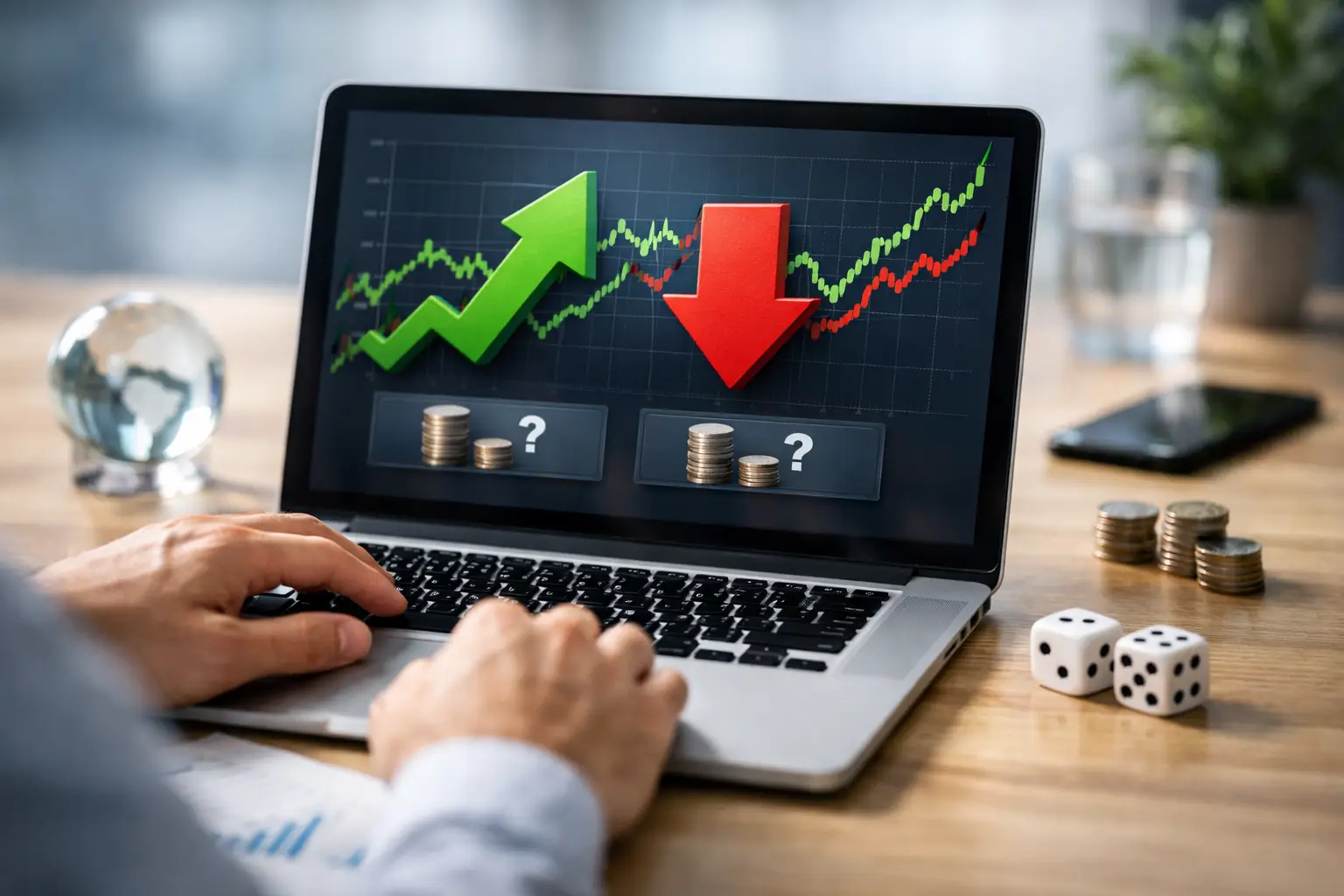
Most people already make predictions all day. They call election swings before the headlines catch up, spot product launches coming, and sense when a team or public figure has lost momentum. Prediction markets for beginners start with that exact instinct, but add a price, a probability, and a chance to prove you were right.
That is the appeal. You are not staring at abstract charts or guessing into the void. You are taking a position on a real-world outcome and seeing the market test your judgement in real time. Done well, it feels less like luck and more like pattern recognition under pressure.
What are prediction markets?
A prediction market is a place where people buy and sell positions on future events. Each market asks a clear question with a defined outcome. Will a film top the box office? Will a company hit a launch date? Will a political event happen by a certain deadline? The market price reflects what participants collectively think is likely.
If a contract is trading at 65p, that usually suggests the market sees around a 65 per cent chance of that outcome happening. The closer the event gets, the more those prices move as new information arrives. News breaks, sentiment shifts, confidence builds or collapses, and the market updates.
This is what makes prediction markets so compelling. They turn opinion into something measurable. It is easy to say you had a feeling. It is harder, and far more interesting, to back that feeling with a position and let the market judge it.
Prediction markets for beginners: how they actually work
The basic mechanics are simple. You choose a market, review the current price, and decide whether the outcome is more or less likely than the market believes.
Say a market asks whether a major artist will release an album before the end of the year, and the price implies a 40 per cent chance. If you think the clues point to a much stronger possibility, that price may look cheap. If you think the rumours are empty and the timeline is unrealistic, it may look expensive.
Your edge comes from the gap between your view and the market consensus. Not every opinion is valuable. The valuable opinions are the ones backed by timing, context, and evidence the crowd has not priced properly yet.
That is why prediction markets sit in a sweet spot between finance, media, and strategy. They reward attention. If you follow technology, culture, sport, politics, business, or internet trends closely, you already have raw material to work with.
Why people use them
Some users come for the earnings potential. Others come for the competition. Many come because prediction feels sharper than passive scrolling and cleaner than products built on pure chance.
There is also a status element to it. Getting a call right before everyone else notices is satisfying. Building a track record of strong judgement is even better. The strongest platforms make that visible through performance history, badges, rankings, or other reputation markers that show you are not just talking a good game.
For beginners, that matters. It shifts the experience from random punts to something closer to public forecasting. You are not just participating. You are building proof that your instincts hold up.
What moves market prices
Beginners often assume prices move only when an event becomes more or less likely in some objective way. In reality, prices move because people react to information, and people are not always perfectly rational.
News is the obvious driver. A statement from a company, a leaked document, an injury update, a policy announcement, or a teaser campaign can all change sentiment quickly. But timing matters just as much as the information itself. A strong signal too early can fade. A weaker signal just before resolution can have more impact.
Liquidity matters too. In active markets, prices often reflect consensus more efficiently because more participants are challenging weak assumptions. In thinner markets, prices can lag or overreact. For a beginner, that means you should not treat every market price as gospel. Sometimes the number is sharp. Sometimes it is simply the best estimate available right now.
How to think like a stronger predictor
The fastest way to improve is to stop asking, “What do I want to happen?” and start asking, “What is already priced in?” That mental switch changes everything.
Strong predictors do not chase headlines. They compare public excitement to actual probability. If everyone is overhyping a story, the smarter move may be the unfashionable one. If the market is underestimating a boring but reliable signal, that is where value can sit.
It also helps to break every market into three layers. First, what has to happen for this outcome to resolve yes? Second, what could stop it? Third, what does the timeline look like? Many beginners focus only on the headline outcome and ignore the chain of events beneath it.
A product launch, for example, is not just about whether a company wants to ship. It depends on manufacturing, approvals, logistics, marketing windows, and leadership discipline. A celebrity announcement is not just about rumours. It may hinge on legal timing, distribution deals, or strategic silence. The sharper your model of the chain, the better your calls.
Common mistakes beginners make
The biggest mistake is confusing confidence with edge. Feeling certain does not mean the market is wrong. If a price already reflects your view, there may be no advantage in taking the position.
Another common error is overreacting to one source. A single post, quote, or leak can move sentiment, but reliable forecasting usually comes from clusters of signals rather than one dramatic moment. You want confirmation, not just excitement.
Beginners also tend to ignore resolution rules. This is costly. Markets settle on specific wording, dates, and criteria. You might be broadly right in spirit and still wrong on the actual market terms. Precision beats vibes.
Then there is emotional tilt. After a good run, people start forcing positions because they feel sharp. After a bad run, they chase losses or abandon a sound process. Neither works. Prediction rewards discipline more than adrenaline.
Risk, regulation, and why trust matters
Not all prediction platforms feel the same, and beginners should care about that. A sleek interface means very little if the product is opaque, unregulated, or unnecessarily complex.
The best experience is one where the rules are clear, payments feel familiar, and responsible-use tools are built in rather than buried. That lowers friction, but it also changes the psychology. You can focus on making better calls instead of trying to decode the platform itself.
This is one reason regulated platforms stand out. They create a framework where users know what they are dealing with. For mainstream audiences, especially those put off by crypto-native complexity or vague market mechanics, that trust layer is not a nice extra. It is the foundation.
How to get started without overcomplicating it
Start narrow. Pick topics you already follow closely and can read better than average. If you track entertainment release cycles, stay there first. If you understand tech product roadmaps or political messaging, begin with those markets. Familiarity is an advantage only when it is specific.
Keep your first goal modest: learn how prices react. Watch what happens before and after major updates. Notice which rumours move a market and which do not. Pay attention to whether your instinct was right for the right reason or merely lucky.
It also helps to keep notes. Not a novel, just a few lines on why you took a view. Over time, this exposes whether your edge comes from timing, subject knowledge, crowd psychology, or all three. A platform like Versus, which combines prediction with educational support and visible performance cues, can make that learning curve feel more structured.
Most of all, think in probabilities. Good forecasters are not trying to be perfect. They are trying to be consistently better calibrated than the crowd.
The real appeal of prediction markets for beginners
The best part is not simply getting paid when you are right. It is seeing your judgement sharpen. You start consuming news differently. You stop being impressed by noise. You learn to separate narrative from likelihood, confidence from evidence, and hot takes from useful signals.
That makes prediction markets more than a pastime. They become a training ground for decision-making. Fast, public, and unforgiving in the best way.
If you are just starting, do not worry about looking like an expert. Focus on building a repeatable process, choosing spots where you genuinely have insight, and letting the scoreboard teach you. Being right feels good. Knowing why you were right is where the real advantage begins.
Predict the world’s next moves.
enter versus™