
Prediction Market Mechanics Explained Clearly
31 August 2026
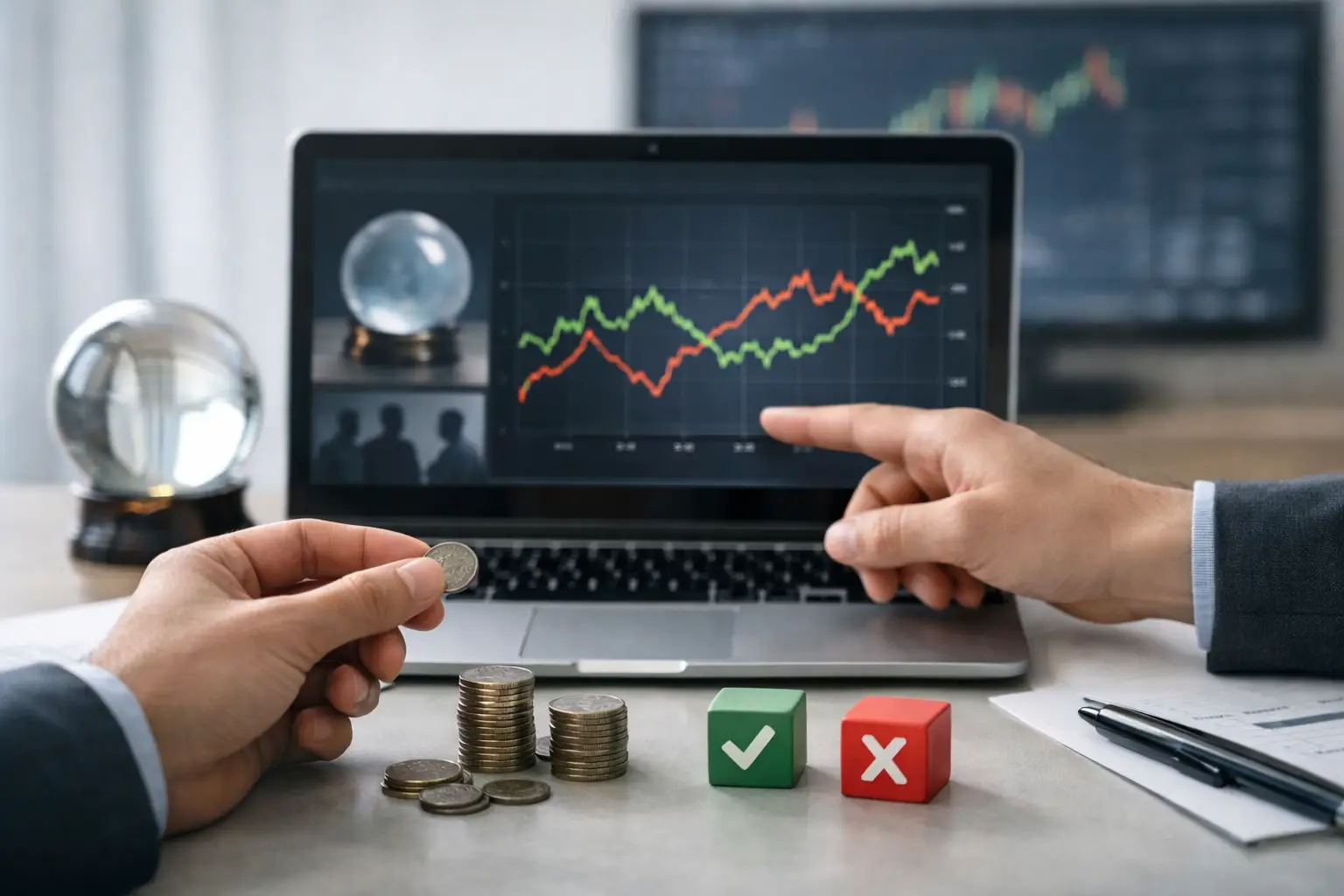
A market trading at 68p is not telling you the future is guaranteed. It is telling you that, right now, participants collectively rate one outcome at roughly 68%. That distinction is where prediction market mechanics become interesting. The opportunity is not in following the crowd blindly. It is in spotting when the crowd has missed something.
A strong prediction is more than a hot take. It has a clear outcome, a time frame, a price, and a settlement rule. Understand those four elements and you can read a market with more discipline, take positions with intent, and build a record around being right.
Prediction market mechanics start with a contract
Most prediction markets are built around a simple question with two possible outcomes: Yes or No. Will a film win a particular award? Will an economic figure come in above a stated level? Will a product launch happen before a deadline?
Each outcome is represented by a contract. A Yes contract pays a fixed amount, often £1, if the stated event happens. If it does not, that contract settles at zero. A No contract works in the opposite direction, according to the market's rules.
If a Yes contract costs 68p, the market is broadly pricing the outcome at a 68% probability. Buy one contract at 68p and, if Yes wins, it settles at £1. Your gross gain is 32p. If No wins, you lose the 68p paid for that contract.
The maths is straightforward. The judgement is not. Before taking a position, ask a sharper question than “Do I think this will happen?” Ask: “Do I think it is more likely than the current price suggests?”
If you believe the real probability is 80% and the market is at 68p, you may see value. If you only think the outcome is likely, but not more likely than 68%, there may be no edge at all.
Price is a live score for collective belief
A prediction market price moves as new information, analysis and attention enter the market. A credible report can change the outlook in seconds. So can a surprise announcement, a key statistic, a public appearance or a detail that changes how the resolution rules apply.
That makes the price useful, but never final. It reflects available belief and available participation, not perfect knowledge. Markets can be highly efficient when a question is clear and heavily watched. They can also overreact to headlines, underestimate specialist knowledge or drift when interest is thin.
The market price is best treated as a benchmark for your own thinking. It forces precision. Instead of saying a launch “feels likely”, you must decide whether it is more likely than 54%, 71% or 88%. That is a much tougher standard, and a far more useful one.
Why prices change before the outcome does
A position can gain or lose value before settlement. Say you buy a Yes contract at 45p. Later, new evidence pushes the price to 62p. If the platform allows you to close the position at that point, you may realise the difference without waiting for the final result.
The reverse is also true. You can be right about the eventual outcome and still see a position fall in value along the way. Markets often move through uncertainty. A short-term price change is not automatically proof that your original view was poor, just as a rising price is not proof that it was sound.
This is where time horizon matters. Some participants aim to trade changing probabilities. Others hold through to settlement because their conviction is tied to the final result. Neither approach is automatically superior. The right approach depends on your research, your risk limits and whether you can explain why the price moved.
Settlement rules decide what “right” means
The wording of a market is not decoration. It is the contract.
Before committing funds, read the full question, the closing time, the source used to verify the outcome and any definitions that control settlement. “Will X happen this year?” can mean very different things depending on whether the date is based on an announcement, an official publication, a public release or a completed event.
Good market design removes ambiguity before money is at stake. It identifies the authoritative source and makes clear what happens if an event is delayed, cancelled or cannot be verified. That protects participants from trying to argue the result after the fact.
Do not trade the headline alone. Trade the exact terms. A clever prediction attached to the wrong interpretation is still a losing position.
Liquidity, spreads and the real cost of a position
The displayed price matters, but it is not the whole picture. In active markets, there are usually more participants ready to buy and sell. That tends to make entry and exit easier. In quieter markets, the gap between the price available to buy and the price available to sell may be wider.
That gap is often called the spread. It means you should consider not only where you expect the market to settle, but whether the available price gives you enough room to be right after any spread, fees or other applicable platform costs.
Market structure varies by platform. Some use matching between participants, while others use a different liquidity design. Either way, the practical principle holds: read the price you can actually take, not just the number you hoped to see.
On a licensed platform such as Versus, transparent market rules, trusted payment methods and responsible-use controls help keep the focus where it belongs: the quality of the call, not unnecessary friction around participation.
Build a view before you see the crowd
The easiest way to become reactive is to open a market, see a number, then invent a reason to agree or disagree with it. Reverse the process.
Start by forming your own estimate from the evidence available. Consider the base rate, the incentives of the people involved, the timeline, credible sources and what would genuinely change the outcome. Then compare your estimate with the market price.
For example, a major technology announcement may attract instant excitement. But excitement is not evidence. Is the claimed launch date realistic given past release cycles? Has the company confirmed production capacity? Are there regulatory hurdles? Does the market wording require a full public release or merely an announcement?
This approach does not guarantee a winning outcome. Prediction markets deal in uncertainty, and even excellent analysis loses sometimes. What it does provide is a repeatable decision process. Over time, that process is far more valuable than chasing whichever market is moving fastest.
Keep a record of the reasoning
A win can be lucky. A loss can be well judged. If you want to improve, record why you took a position, what probability you assigned, what information you relied on and what would have changed your mind.
After settlement, review the decision rather than just the payout. Were you wrong about the facts, the timeline, the wording or the probability? Did you size the position sensibly? Did you react to noise? Your track record becomes more meaningful when it captures judgement, not merely results.
That is also how prediction becomes a reputation game. Consistent thinking, measured positions and a visible history of good calls say more than one dramatic win ever could.
Risk management is part of being sharp
A high-conviction view is not a reason to ignore limits. Every market can surprise you, and binary outcomes are unforgiving at settlement. A contract either pays according to its terms or it does not.
Set a budget before you participate and treat it as entertainment spend you can afford to lose. Avoid trying to recover losses by increasing your stake or jumping into a market you have not researched. If a result is affecting your mood, your finances or your ability to make sensible decisions, step back and use the available safer-play tools.
The strongest participants protect their ability to keep thinking clearly. They do not confuse confidence with certainty, and they do not let one result define their next call.
A price is a challenge, not an instruction. Read the rules, make your estimate, respect the risk and take a position only when your reasoning is stronger than the noise. Being right feels good. Knowing why you were right is how you get better.
Predict the world’s next moves.
enter versus™