
What Is the Legal Status of Prediction Markets?
10 June 2026
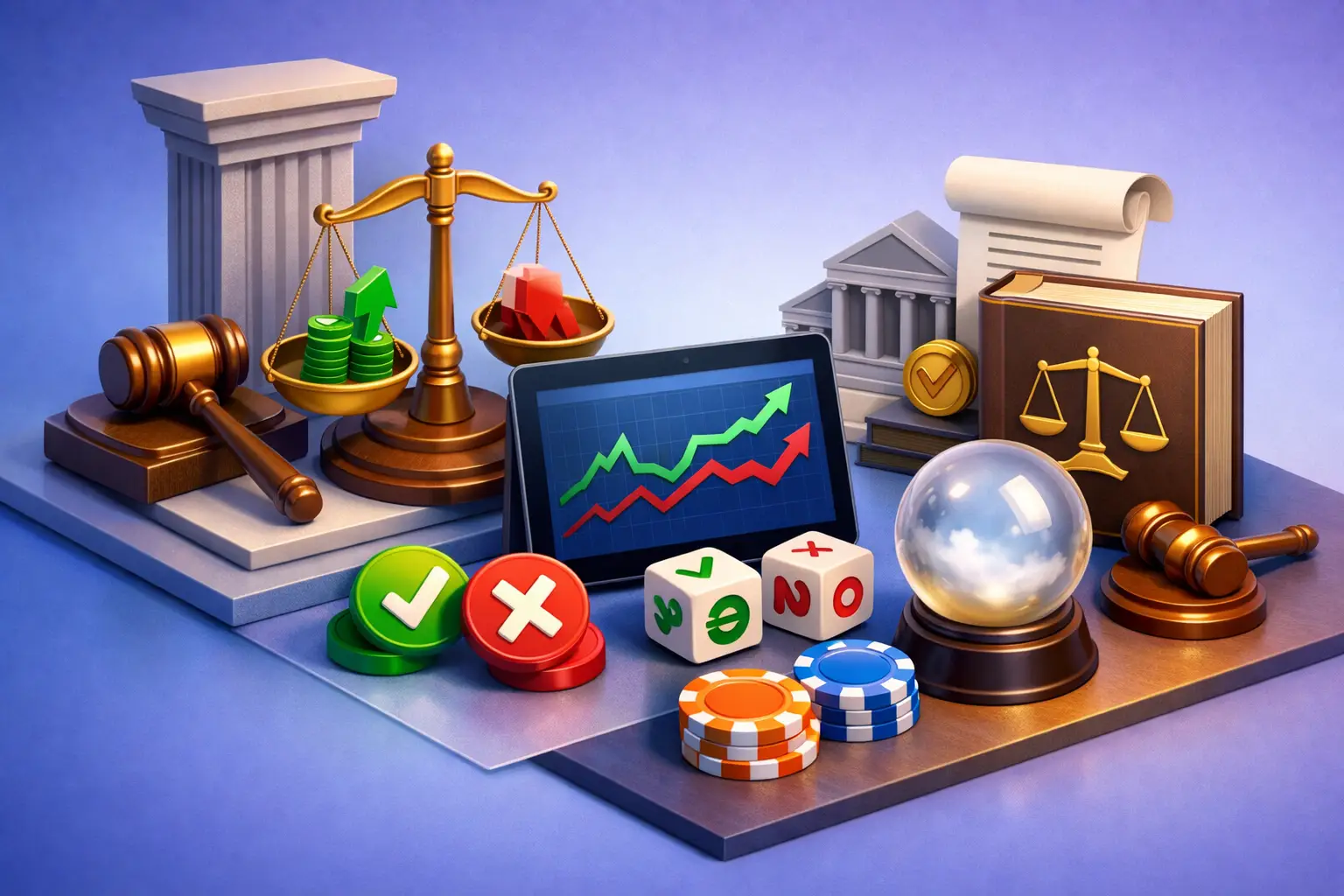
If you can earn money from being right, regulators will want to know exactly what kind of product they are looking at. That is why the legal status of prediction markets is not a throwaway detail or a box-ticking issue. It shapes who can offer them, where users can access them, what rules apply, and how much trust a platform can realistically earn.
For users, this is the difference between informed participation and guessing blind. For platforms, it is the line between a credible, regulated product and something that could vanish the moment scrutiny arrives. Prediction is exciting when your edge counts. It is far less exciting when the legal foundation is shaky.
Why the legal status of prediction markets is complicated
Prediction markets sit in an unusual category because they borrow features from several worlds at once. They can look like financial trading because prices move with sentiment and information. They can feel like gaming because users take positions on future outcomes. They can resemble media and social products because participation is often tied to culture, politics, sport, entertainment, or public events.
That overlap is exactly why there is no single global answer. A regulator in one country may treat a prediction market as gambling. Another may see certain formats as financial instruments. A third may permit some event contracts while banning others outright. The same product mechanic can be lawful in one jurisdiction and restricted in another depending on how it is structured, marketed, and licensed.
This is not just legal hair-splitting. Product design matters. If a market offers cash outcomes based on uncertain future events, the questions come quickly. Who regulates it? Is the operator licensed? Are users protected? Is the event type allowed? How are funds handled? What safeguards are in place to prevent harm, market abuse, or misleading claims?
How regulators usually assess prediction markets
Most regulators do not start with branding. They start with function. A platform can call itself a forecasting tool, a social prediction app, or an entertainment product, but the legal analysis usually turns on what users are actually doing.
If users stake money on an uncertain outcome and receive a payout if they are right, that can pull the product into gambling law. If contracts behave more like tradable derivatives tied to events, financial regulation may come into play. In some cases, both frameworks become relevant in different ways, especially where the platform crosses borders or offers a broad range of market types.
The key variables tend to be straightforward, even if the legal interpretation is not. Regulators look at whether real money is involved, whether there is a prize or return, whether chance or skill is central, whether the market can be traded or exited before settlement, and whether the event itself raises public policy concerns.
That last point matters more than many users realise. Not every event is viewed equally. Markets on entertainment releases or macro trends may be treated differently from markets tied to elections, violent events, or sensitive public outcomes. Legality is often not just about mechanism. It is also about subject matter.
The UK position on the legal status of prediction markets
In the UK, the most practical lens is gambling regulation. If a platform allows users to risk money on the outcome of future events for a return, it will often fall within a regulated gambling framework unless a specific exemption or different legal classification applies.
That means licensing is not optional for businesses operating in scope. A properly authorised operator is expected to meet standards around fair terms, customer protection, anti-money laundering controls, age checks, safer gambling tools, complaints handling, and the integrity of the product itself. That is the baseline for legitimacy.
For UK users, the legal status of prediction markets is therefore less about abstract theory and more about whether the operator has genuine permission to offer the product. A regulated platform has to play by visible rules. An unlicensed operator may still be accessible online, but accessibility is not the same as legality, and it is certainly not the same as accountability.
This is one reason compliance is not a dry back-office function. It is part of the user proposition. If a platform wants mainstream trust, it needs more than slick design and sharp odds. It needs a legal structure that can stand up under scrutiny.
Why the US and other markets look different
The picture changes sharply once you leave the UK. In the US, prediction markets can trigger both state-level gambling concerns and federal financial regulation depending on the product. Some event-based contracts have operated under specific regulatory oversight, while others have faced restrictions, enforcement action, or prolonged legal debate.
The result is a patchwork. Users often assume that if a product is visible online, it must be legal everywhere. It is not. Platforms may exclude certain states, certain categories of users, or certain event types. They may offer one set of markets in one country and a very different set elsewhere.
Other jurisdictions take their own view again. Some are relatively open to regulated gaming products. Some have stricter prohibitions. Some are still catching up conceptually, which creates grey zones that can shift fast once a regulator decides to act.
For any operator with international ambitions, this creates a real strategic trade-off. Move fast without legal clarity and you risk shutdowns, fines, or reputational damage. Build market by market with licensing and controls, and growth may be slower, but the foundation is stronger.
Legal does not only mean licensed
Users often reduce the question to one line: is it legal or not? In practice, there are layers.
A platform may be licensed in one jurisdiction but not available lawfully in another. It may be legally authorised to offer some categories of markets but not others. It may satisfy one regulator’s expectations while failing another’s. It may also be technically compliant on paper while still creating problems through weak consumer protection or unclear product communication.
That is why serious platforms build around more than minimum permission. They think about responsible use, transparent pricing, clear settlement rules, payment integrity, identity checks, and how users understand risk. Regulation is the floor. Trust is earned above that line.
For a category like prediction markets, that matters because users are increasingly alert to the difference between speculation with structure and speculation dressed up with marketing. The strongest products do not just ask people to take a position. They make the rules legible.
What users should check before taking part
If you are assessing whether a prediction market is on solid legal ground, start with evidence, not slogans. Can the operator clearly state where it is licensed and who regulates it? Are the terms on eligibility, geography, and payouts easy to find? Does the product explain how markets are settled and what happens in edge cases?
Then look at the user protection layer. Are there deposit controls, affordability checks where relevant, and tools to limit activity? Are payment methods familiar and traceable rather than intentionally obscure? Is the platform trying to attract informed participation, or is it leaning on hype and urgency?
These are not minor details. They tell you whether the business expects to be around for the long run. A regulated, consumer-facing platform such as Versus builds value partly by making prediction feel more credible, more accessible, and less dependent on opacity. That only works when the legal and operational framework is taken seriously.
The future legal status of prediction markets
Prediction markets are unlikely to stay in a neat category, because the market itself is evolving. As products become more social, more data-driven, and more mainstream, regulators will keep asking the same core question in new forms: what exactly is this, and how should it be supervised?
Some jurisdictions may create more tailored rules over time. Others may fold prediction products into existing gambling or financial frameworks with tougher enforcement. There is also likely to be more scrutiny of event categories that touch politics, public safety, or financial stability.
That means the winners in this space will not just be the loudest brands or the fastest builders. They will be the operators that treat compliance as part of the product, not a drag on it. In a category built on being right, legal clarity is a competitive edge.
If you want to test your judgement in prediction markets, back your intelligence on a platform that can show its working as clearly as you can show yours.
Predict the world’s next moves.
enter versus™